
How to Get Court Records
Go to the office that created the record in the first place. Deborah D. Jackson is the Clerk of Superior Court. She holds the Superior civil and criminal dockets and files. Her counter sits at 113 N Main Street, Suite 109, Greensboro, Georgia 30642. Hours run Monday through Friday, 8:00 a.m. to 5:00 p.m. The phone is 706-453-3340. Magistrate, Probate, and the county Traffic office share the same street address in Suite 113. That office is reachable at 706-453-3346.
Not every detail is published, so call ahead before you mail money or original documents. Confirm the counter rules, payment options, and expected turnaround for certified copies by phone.
- Locate the court, case number, filing year, and exact paper or docket range needed.
- For Superior records, use Georgia E-Access to reach PeachCourt, or contact Suite 109.
- For Magistrate, Probate, or county traffic records, contact Suite 113. Municipal records go to the issuing city court.
- Ask whether inspection, a plain copy, a certified copy, or mail delivery is available and what current charge and payment method apply.
- For an old file, ask about bound books, paper storage, microfilm, or archive retrieval. For a transcript, identify the court reporter.
The clerk has no posted terminal, mail form, or drop box for certified copies, and no confirmed turnaround time. Call before you send money or originals.
Greene County Clerk Record Counter
The Superior clerk holds the court records for Greene County Superior Court and certifies copies of them. That office registers and keeps the official documents filed in both civil and criminal proceedings. Juvenile questions go there too. Access to juvenile material, though, is restricted.
Clerk of Superior Court
Deborah D. Jackson
113 N Main Street, Suite 109
Greensboro, GA 30642
706-453-3340
Monday through Friday, 8:00 a.m. to 5:00 p.m.
Magistrate, Probate, and Traffic
113 N Main Street, Suite 113
Greensboro, GA 30642
706-453-3346
Generally Monday, Tuesday, Thursday, and Friday, 8:00 a.m. to 5:00 p.m., closed noon to 1:00 p.m.
1034 Silver Drive is county administration, not the court-record counter.
Types of Court Records
A docket is not the same thing as a case file. The docket, or register, is simply the chronological index. The case file holds the documents that index points to. Those documents include a complaint, answer, motion, order, indictment, sentence, judgment, exhibit, or transcript. A certified copy is a clerk-authenticated reproduction. Use it when official proof of a court record is required.
- Superior civil and domestic docket entries and filed papers
- Superior criminal charges, pleas, orders, dispositions, and sentence records
- Magistrate civil, dispossessory, garnishment, warrant, bond, and preliminary records
- Probate estate, will, guardianship, license, traffic, and limited misdemeanor records
- Municipal traffic and ordinance records held by the issuing city
Transcripts are another matter. The clerk cannot produce one, because it comes from the court reporter instead. When the docket lists a transcript but no copy appears online, ask the clerk who the reporter was so you can request it directly.
Greene County Record Products Compared
Pick the right product and you save both money and waiting time. A register of actions can tell you when an order was entered. For the terms themselves, you need the actual order. Certification from the clerk authenticates a document. It adds no new case content beyond what the record already holds.
| Product | What it provides | Typical route |
|---|---|---|
| Docket or register | Chronological entries, settings, and outcomes | PeachCourt account or clerk inspection |
| Filed document | The text of a pleading, order, judgment, or other paper | Provider image or clerk copy |
| Certified copy | A clerk-authenticated reproduction | Request from the responsible clerk |
| Transcript | A record of reported proceedings | Request from the court reporter |
A picture of a page is not a certified Greene County record. When you ask for authentication, name the exact judgment, order, or docket page you need.
What a Court Record Contains
Uniform Superior Court Rules 39.2 and 39.3 spell out the detailed docket fields for both civil and criminal cases. The inventory here summarizes fields that may exist in the clerk's record. It does not promise that every field or image shows up in PeachCourt's public account view.
| Header | Court, county, action number, filing date, case style, judge, and status. |
|---|---|
| Parties and counsel | Party roles, attorney names, and bar information where applicable. |
| Chronology | Service, filings, motions, notices, hearings, orders, pleas, and judgments. |
| Settings | Date, time, hearing type, judge or courtroom, and reset notation. |
| Disposition | Outcome, judgment or sentence details, costs, and relevant dates. |
| Review history | New-trial motions, notices of appeal, remittitur, and record cross-references. |
| Storage references | Minutes, final-record pages, bound records, or storage-box references. |
Current rules call for protected identifiers to be redacted. A public register can still note that an exhibit or transcript exists, and that note does not put the underlying material online for anyone to open.
Greene County ORA Form Limit
The county's online Open Records Act form reaches only Board of Commissioners departments. Greene County states plainly that it does not keep records for court-related offices. Send a Superior, Magistrate, Probate, Traffic, or municipal file through that county form. It never lands with the right clerk. Court records in Greene County live with the clerks, not the commissioners.
There is a legal line here. The Georgia Attorney General's court-record explanation says the Georgia Open Records Act does not apply here. Superior, State, Probate, and Magistrate Courts are outside it. That same official explanation notes court records stay public through court procedures instead. The distinction matters. Request a case file from a clerk rather than county hall.
Send a request for a Greene County court file to the clerk of the court that holds it. An agency open-record request fits only a record that agency itself keeps.
Certified Copies and Fees
The Superior clerk posts no plain-copy, certification, exemplification, search, mailing, or payment amounts. The lower-court pages list no copy schedule either. Ask the clerk for a quote before you settle on a request format. O.C.G.A. §15-6-77 sets a state framework for clerk fees. Local handling and the current price of a specific product still have to come from the office itself.
| Request | Custodian | Known amount or status |
|---|---|---|
| Superior docket or filed paper | Suite 109 | Current Greene copy and certification quote not located |
| Magistrate, Probate, or traffic copy | Suite 113 | Current copy quote not located |
| County agency ORA copy | County agency custodian | First 15 minutes no charge and generally 10 cents per page; courts excluded |
| Transcript | Court reporter | Current Greene reporter and rate not located |
One warning on Superior criminal court costs. The $100 minimum under Rule 36.15, plus applicable surcharges, is a court cost, not a copy fee. The two charges serve different purposes.
Greene County Agency Records Contrast
The Attorney General's agency request guidance shows how an Open Records Act request reaches the agency custodian. That official state route is what the page displays.
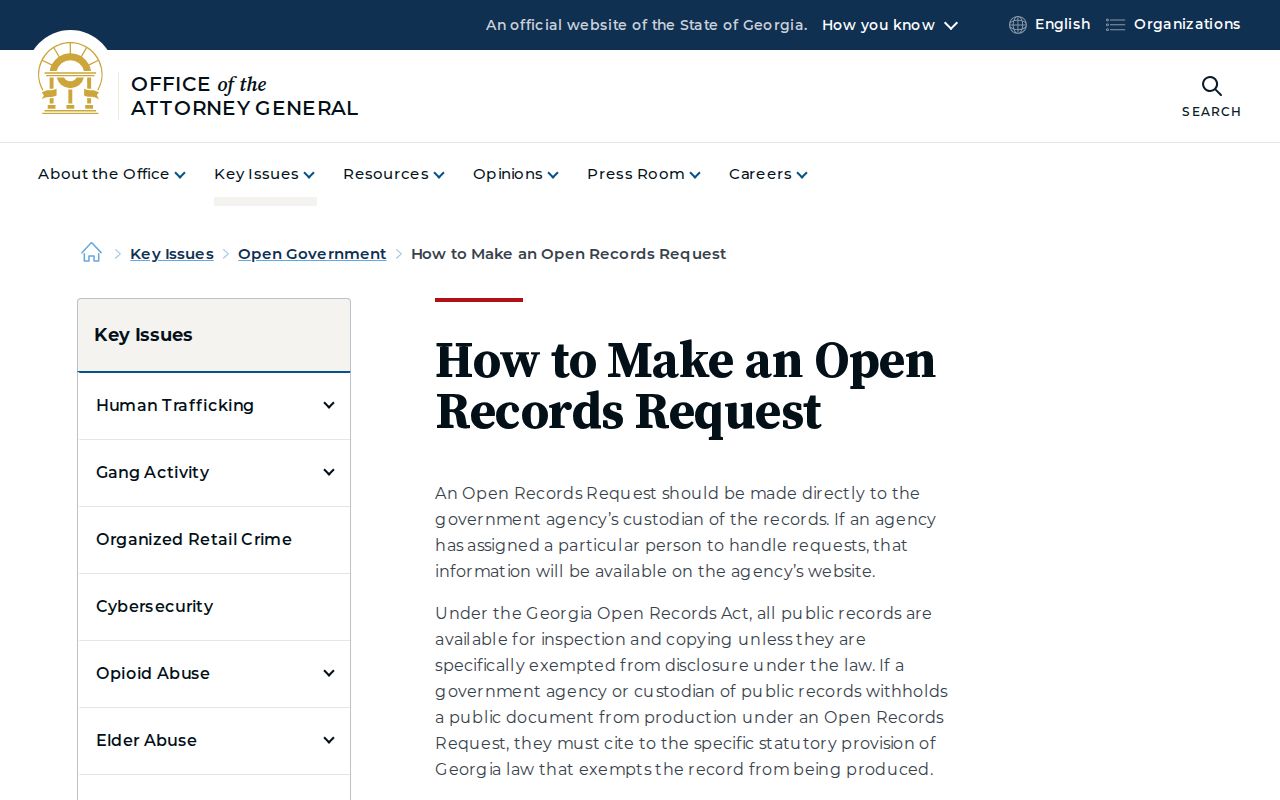
The Attorney General's agency request guidance walks through how an Open Records Act request reaches the agency custodian. That official state page shows the route in the state's own words.
Greene County Older File Requests
Not every Greene County court record lives on a screen. Rule 39 still points lawyers and clerks to paper. It names docket books, minutes, final records, pages, and storage boxes. So an older case may sit in paper, on microfilm, or in a box across town. Greene County's official sources name no first year online. They list no full microfilm inventory, no archive site, and no plan to digitize. Ask instead of assuming.
Pick up the phone with the case number and filing year ready. Confirm whether the file is paper, bound, filmed, electronic, or stored off site. Ask if pulling it adds time or cost, and whether chosen pages can be mailed. Keep the case number plus the date printed on each copy. When PeachCourt shows an index entry with no document behind it, request that exact entry. Don't pay for the whole file blindly.
Note: An older Greene County file can exist anyway. No search result or image has to show up online.
Public Access and Sealed Records
The public's right to look is broad. Uniform Superior Court Rule 21 makes Superior Court records open to inspection unless some law or rule limits access. Rules 21.1 through 21.6 cover court-ordered restrictions and material that needs protection. Rules 36.16 and 36.17 treat e-filed documents like paper in legal force and public access, while putting redaction duties on the filers, not the clerk.
Access limit: Juvenile, adoption, sealed, protected family-violence, and other restricted records may be hidden, redacted, or available only by court order.
A blank result is not always a sealed file. It can mean you searched the wrong court. It can mean you hit an old file or met an account wall. Write down the case number and whatever entry you can see. Then ask the clerk which rule applies. A redacted copy, a docket-only view, or a motion-and-order route may still be open to you. The county ORA form cannot beat a judge's restriction.